Wednesday, November 24, 2010

Trickster

Trickster
He was the progeny of the giants Farbauti and Laufey and Odin was his blood-brother ("Loki" 1). He is recounted "as the contriver of all fraud and bears many names that reflect his character as a deceiver" ("Loki" 1). The Aesir considered him one of their own and at times, their enemy. Loki is a shapeshifter and can adopt any form. He is a complex character, possessing the attributes of a scheming conniver and a daring malcontent. While he  lived with the Aesir, Loki became progressively worse through his behavior. The end result culminated in Balder's death. ("Loki") With his mistress Angrboda, the giantess, he sired three monsters "the goddess of death, hel, the monsterous serpent surrounding the world, Jormungand, and the wolf Fenrir" ("Germanic Religion and Mythology" 9).  "Loki's long suffering wife Sigyn stayed by his side to the very end ("Loki").

Loki is the prototypical con man. In Eddic narratives, he is portrayed as helping his brethren sort out problems caused by him from the outset. Demonstrations of Loki's propensities are in the tales of Sif's sheared hair, or the orchestration of Idunn's kidnapping and rescue. Loki's schemes were aided through his proficiency at will to change sex or form ("Loki" 2). Loki's "generally course disposition, as well as his hostilitility towards the other Norse gods is well attested" ("Loki" 2). The Lokasenna describes a portentous visit to Asgard hall where Loki proceded to defame, mock, and insult everyone in attendance. Various tales reference his disceptions, numerous thefts and preconceived murder of Balder. Loki's ultimate destiny was to lay at Ragnarok, where he would play his evil role to the bitter end ("Loki" 2). "Loki gradually becomes god and devil combined, and ends by being an exact counter part of the mid-evil lucifer, the prince of lies, the originator of deceit, and the backbiter of the Aesir" (Guerber 7).

"Germanic religion and mythology." Encyclopædia Britannica. 2010. Encyclopædia Britannica Online. 07 Nov. 2010 <http://www.britannica.com/EBchecked/topic/231102/Germanic-religion-and-mythology>.

Guerber, H. A. Myths of Northern Lands. New York: American Book Company, 1895. Print.

"Loki." Encyclopedia Mythica. 2010. Encyclopedia Mythica Online.29 Oct. 2010 <http://www.pantheon.org/articles/l/loki.html

"Loki."New World Encyclopedia. 3 Apr 2008, 23:37 UTC. 30 Oct 2010, 21:37 http://www.newworldencyclopedia.org/entry/Loki?oldid=687165.

Tuesday, November 23, 2010

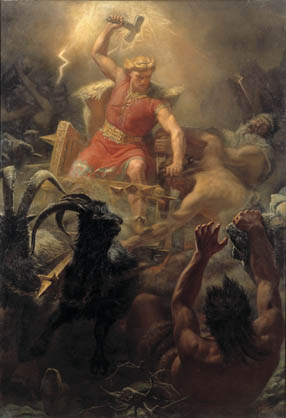
Thunder God

 The Thunder God "guarded men and their labors from the wild forces of nature, personified as giants" (Munch 10). He held dominion over the heavens and presided over the changing seasons of rain and harvest. Among the Aesir, Thor was the god of fertility, and before all, he was the ruler of lightning and thunder. His most precious possessions were his hammer Mjollnir and Megingjord the girdle of strength. As Thor rode across the heavens in his chariot, giants would feel his wrath, and thunder would follow in his wake. He was a champion among all others and gave proof through his many great deeds. Sif, the goddess of the golden hair was his wife and their offspring were Modi and Thrud. His mistress was Jarnsaxa the giantess. Joined with her gave life to Magni To our fore bearers, Thor was strong, tall and handsome with a dignified aire. He had a fair complexion to go with his red beard and at the ready Mjollnir clenched in his hand (Munch 10-12).

In the Prose Edda Thor was depicted as a protector of "Asgard and Midgard from the forces of chaos and disaster" ("Thor" 2) in his many confrontations with the Jotun. Thor was hot in temper and rash in judgment ("Thor" 2). "Now and then he might chance to leap before he looked" (Munch 12).

A considerable number of myths center on Thor's adventures. One legend recounts a fising trip with Hymir the giant and their encounter with Jormungandr the Midgard serpent. In Thor's contest with the giant king Utgaroa, magical powers are used to outwit him. The craftier side of his nature is shown in a riddling contest with the dwarf Alavis to save his daughter from an unhappy betrothal ("Thor" 2-3). On the day of Ragnark "Thor shall put to death the Midgard serpent, and shall stride away nine paces from that spot; then shall he fall dead to the earth" ("Thor" 3).


Munch, Peter A. Norse Mythology: Legends of Gods and Heroes. New York: The American-Scandinavian Foundation, 1928. Print.

Sunday, November 21, 2010

The Wanderer

Odin
 Odin is "the chief divinity of the Norse Pantheon, the foremost of the Aesir" ("Odin"). He was sired by Bor and born of Bestla. Odin is named the Allfather, for indeed he is the patriarch of the gods. Joined with Frigg, he beget three sons, Hermod, Balder and Hod. With the goddess Jord, Odin created Thor, and by Grid the giantess, he conceived the god Vidar ("Odin").

Odin is believed to be the god of victory's conflict struggle with death. He is know for his wisdom and reverence for magic. Odin is the benevolent father of poetry and the soothsayer of prophecy, and in his free time, a sporting man. He resides at the shelf of the slain in Asgard and from his throne beholds the affairs of the nine world. To Valhalla he brings the Valkyries chosen few to prepare for Ragnarok ("Odin").

In contrast to other friendly father gods, Odin is not a proveyer of moral battlefield virtue. A warrior's god who frequently snatches victory from the jaws of defeat, by method of trickery and guile, or even downright deception. Upon assuming the mantel as the heroic dead sovereign, Odin practices a devil may care game with their lives. Through his audacious manner, he provokes conflict under dubious means with  sometimes catastrophic result ("Odin" 1). On the authority of the Prose Edda, of Snorri Sturluson, "Odin is much more likely to arouse awe and fear than love, respect or veneration" ("Odin" 2). Interpretation of Odin's Old Norse name connotes frenzy or rage, leaving behind the impression of battle or the personification of a berserker ("Odin" 2).  
The Wanderer

What has survived of Norse Mythology comes from the text of the Poetic and Prose Eddas, blended with surviving legends and folk lore ("Norse Mythology" 2). Odin is characterized as being a shapechanger in the form of an old man with a beard and one eye. He carries with him a staff and wears a traveling coat with a wide brim hat. Tales of Odin speak of his nine-days of crucifixion to receive the power to conjure magic and the relinquishment of his eye to acquire the gift of prophecy. In the account of theft, he steals poetic inspiration. And as featured in the heroic sagas blesses temporary victory to mortal men at great cost ("Odin" 3-4).


http://static.newworldencyclopedia.org/1/1d/Georg_von_Rosen_-_Oden_som_vandringsman%2C_1886_%28Odin%2C_the_Wanderer%29.jpg


"Odin." Encyclopedia Mythica. 2010. Encyclopedia Mythica Online.
29 Oct. 2010 <http://www.pantheon.org/articles/o/odin.html


http://static.newworldencyclopedia.org/e/ef/Odin_Vendel_helmet.jpg


"Odin." New World Encyclopedia. 3 Apr 2008, 23:37 UTC. 30 Oct 2010, 21:37 http://www.newworldencyclopedia.org/entry/Odin?oldid=687165.

"Norse Mythology." New World Encyclopedia. 3 Apr 2008, 23:37 UTC. 30 Oct 2010, 21:37 http://www.newworldencyclopedia.org/entry/Norse_Mythology?oldid=687165.

Sunday, November 7, 2010

Norse Destiny

  Norse Mythology is the ritual and spiritual beliefs of pre-Christian, Nordic peoples in geographic areas "extending from the Black Sea across Central Europe and Scandinavian to Iceland and Greenland" ("Germanic Religion and Mythology" 2 ). Their bewitching tales live on in our imaginations interwoven with folklore and exotic spiritual beliefs. The Nordic Gods live again to rule the universe in our collective revelation ("Germanic Religion and Mythology" 3).


 "The Gods of Norse and Germanic Mythology have left numerous traces in elements of everyday life" ("Norse Mythology" 7). Traces of their profound influence in our everyday lives are personified in our choice of names for the days of the week. Tuesday is Tyr's day, Wednesday is Wodin's day, Thursday is Thor's day, and Friday is Freyja's day ("Norse Mythology" 7). The concept of destiny is an ancient Nordic belief, which is embraced by peoples all over the world. Whether they be a romantic, a warrior, or individuals just simply trying to survive the drudgery of their everyday lives. The Christian belief in Hell also owes a lot to the Old Norse Faith in the incarnation of Hel's punishment ("Norse Mythology" 7). "The sacrifice to Freyr" ("Norse Mythology" 7) is incorporated into our Yuletide traditions with the presentation of the Christmas ham ("Norse Mythology" 7).

Attempts to revive the old faith in Europe and America have occurred throughout the past two centuries and survive today ("Norse Mythology" 7). As the "Aesir Faith, Odinism, Wotainism...or Heathenry" ("Norse Mythology" 7). Neo- Paganism is an official religion for practitioners throughout Europe.
Intellectuals have influenced popular culture through their romantic interpretations of Norse Mythology. Classical composer Richard Wagner's visionary work is thoroughly rooted in Norse Mythology ("Norse Mythology" 7). Wagner's most famous composition the Ring Cycle tells "Tales of Odin, Frigga, Loki, the Valkyries, and Ragnarok" ("Norse Mythology" 7). The Lord of the Rings written by J. R. R. Tolkien was inspired by the pagan beliefs of indigenous Northern Europeans. The literary world owes a great deal for the inspirational unleashing of the genre's creative forces to Norse Mythology. And without that primordial creation, our fantasy world would be a shadow of todays' thriving genre. There would be no dwarfs, elves, or frost giants  ("Norse Mythology" 7-8). And in an expansion of  mythological horizons, Norse creations have been found in a diversity of media, from Japanese animation to comic books and video games ("Norse Mythology" 8).

"Germanic religion and mythology." Encyclopædia Britannica. 2010. Encyclopædia Britannica Online. 07 Nov. 2010 <http://www.britannica.com/EBchecked/topic/231102/Germanic-religion-and-mythology>.

"Norse Mythology." New World Encyclopedia. 3 Apr 2008, 23:37 UTC. 30 0ct 2010, 21:37http://www.newworldencyclopedia.org/entry/Norse-Mythology?oldid=687165.

http://www.standups.org/pictures/436.jpg

http://starvingwritersbooks.com/bookstore/images/LOTRBOXSET.jpg

Sunday, October 31, 2010

Visions of The Gods

timelessmyths
Norse Mythology is an interesting contrast between our complex modern world and man's simplier distant past. I find comfort in reading tales of simpler times when man and nature were one. When man struggled for survival, with the help or hindrance of the Gods and his own natural abilities. Man could survive in the wilderness through self-reliance, physical strength, and his keen intellect. The common man could solve his problems and everything had a simple explanation. Through oral tradition, the Gods spread their stories and lessons to live by. The world and all its problems had answers and God's ruled that mystical place.

"Norse or Scandinavian Mythology comprises the pre-Christian legends and religious beliefs of the Scandinavian people and Northern Germanic tribes" ("Norse Mythology" 1). I discovered my cultural heritage through the words printed on ancient texts. My imagination takes me back to a time where I can find my roots. The Aesir were "The Collective name for the Principal Race of Norse Gods" ("Aesir" 1). who ruled over mortal men ("Aesir" 1). The Gods and Godesses possessed personal attributes men and women find appealing: Intelligence, beauty, strength, courage, honor, knowledge of right and wrong, and want of the best things in life. And, at the same time, they connect us to our past. Their adventures create anticipation and excitement and their vulnerabilities make them all too real. Their feet of clay resonate with us in our own struggles with survival in this complex modern world.

"Aesir." Encyclopedia Mythica. 2010. Encyclopedia Mythica Online.
29 Oct. 2010 <
http://www.pantheon.org/articles/a/aesir.html>.
http://www.timelessmyths.com/norse/gallery/helm1.gif
"Norse Mythology." New World Encyclopedia. Retrieve 21:37, October 30, 2010 from http://www.newworldencyclopedia.org/entry/norse-mythology?oldid=687165>.