
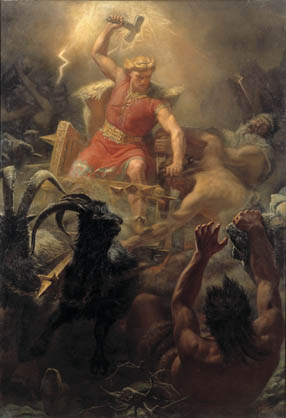
 To our fore bearers, Thor was strong, tall and handsome with a dignified aire. He had a fair complexion to go with his red beard and at the ready Mjollnir clenched in his hand (Munch 10-12).
In the Prose Edda Thor was depicted as a protector of "Asgard and Midgard from the forces of chaos and disaster" ("Thor" 2) in his many confrontations with the Jotun. Thor was hot in temper and rash in judgment ("Thor" 2). "Now and then he might chance to leap before he looked" (Munch 12).
A considerable number of myths center on Thor's adventures. One legend recounts a fising trip with Hymir the giant and their encounter with Jormungandr the Midgard serpent. In Thor's contest with the giant king Utgaroa, magical powers are used to outwit him. The craftier side of his nature is shown in a riddling contest with the dwarf Alavis to save his daughter from an unhappy betrothal ("Thor" 2-3). On the day of Ragnark "Thor shall put to death the Midgard serpent, and shall stride away nine paces from that spot; then shall he fall dead to the earth" ("Thor" 3).
Munch, Peter A. Norse Mythology: Legends of Gods and Heroes. New York: The American-Scandinavian Foundation, 1928. Print.
"Thor." New World Encyclopedia.3 Apr 2008, 23:37 UTC. Oct 2010, 21:37 http://www.newworldencyclopedia.org/entry/Thor?oldid=687165.

No comments:
Post a Comment